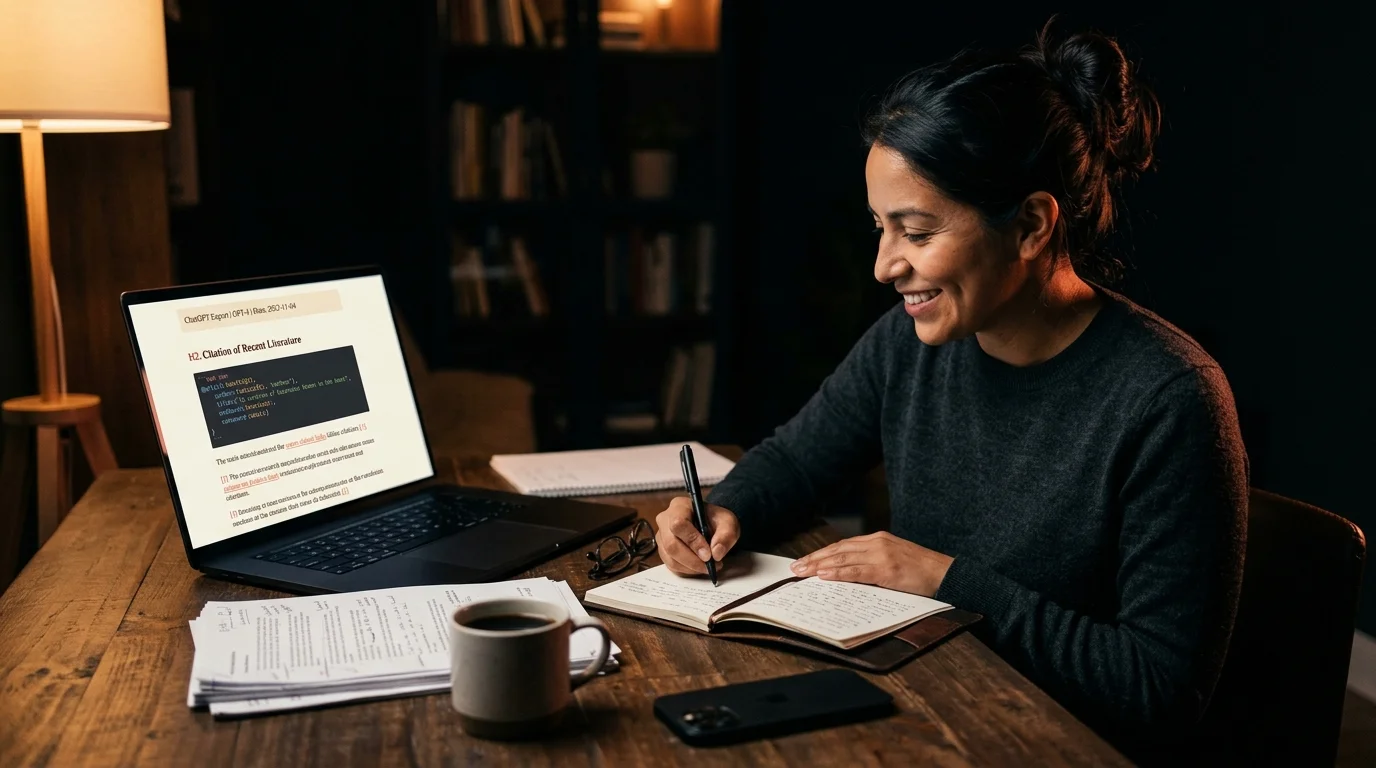
How to Cite AI Conversations in Research and Professional Writing
A chat URL is not a citation. Here is the export, archive, and reference workflow that keeps ChatGPT, Claude, and Gemini sources reproducible under peer review.
A citation that points at a chat URL nobody else can open is not a citation. Academic style guides have caught up with AI tools faster than most writers realize, and the rules are stricter than a blog post. APA wants the model name, the prompt, the date, and the developer. MLA wants the prompt as a title. Chicago wants a date-stamped retrieval note. None of these survive in a screenshot.
The problem is that ChatGPT, Claude, and Gemini share links break, get rate-limited, or expire when an account is closed. A reviewer who cannot reach your source will treat it as missing. The fix is to keep the exported markdown of the conversation, version it, and cite the saved document instead of the live URL. Here is the workflow that holds up under peer review and editorial scrutiny.
What the style guides require
APA 7th edition treats a generative AI response as personal communication from the model, with the company as the author. The format is OpenAI. (2026). ChatGPT (June 26 version) [Large language model]. https://chat.openai.com, with the prompt described in the surrounding prose. The American Psychological Association posted its official guidance in 2023 and has not loosened it since. MLA wants the prompt as the title in quotes, followed by the tool, the version, the developer, the date, and the URL.
Chicago accepts either an inline parenthetical with a retrieval date or a full footnote. The common thread across all three styles is reproducibility. A reviewer needs to know which model, which version, which prompt, and which day. None of those four things are visible in a screenshot of a chat panel. The reviewer has to take your word for the prompt, the date, and the version. That is the gap a saved markdown file closes.
What every saved source needs
Before you cite anything, the saved file itself needs to carry enough metadata for a reviewer to reproduce the lookup. A bare markdown dump without context will not survive a careful editor. Keep this short list pinned next to your writing folder and run every export through it. The four items below are the minimum APA, MLA, and Chicago all share:
- Model and version, like
Claude 3.7 SonnetorChatGPT 5 (June 26, 2026 version). - The verbatim prompt, including any system instructions or pasted context.
- The retrieval date, matching the modification date on the saved file.
- The developer name, since the company is treated as the author across styles.
A header block at the top of the markdown file holds all four cleanly and survives every renderer. Put it above the first H1 so it shows up in every export, every PDF print, and every shared copy. Future-you will thank present-you the first time a reviewer asks for the source. Reviewers who see the metadata up front rarely ask follow-up questions.
Export the conversation as the primary source
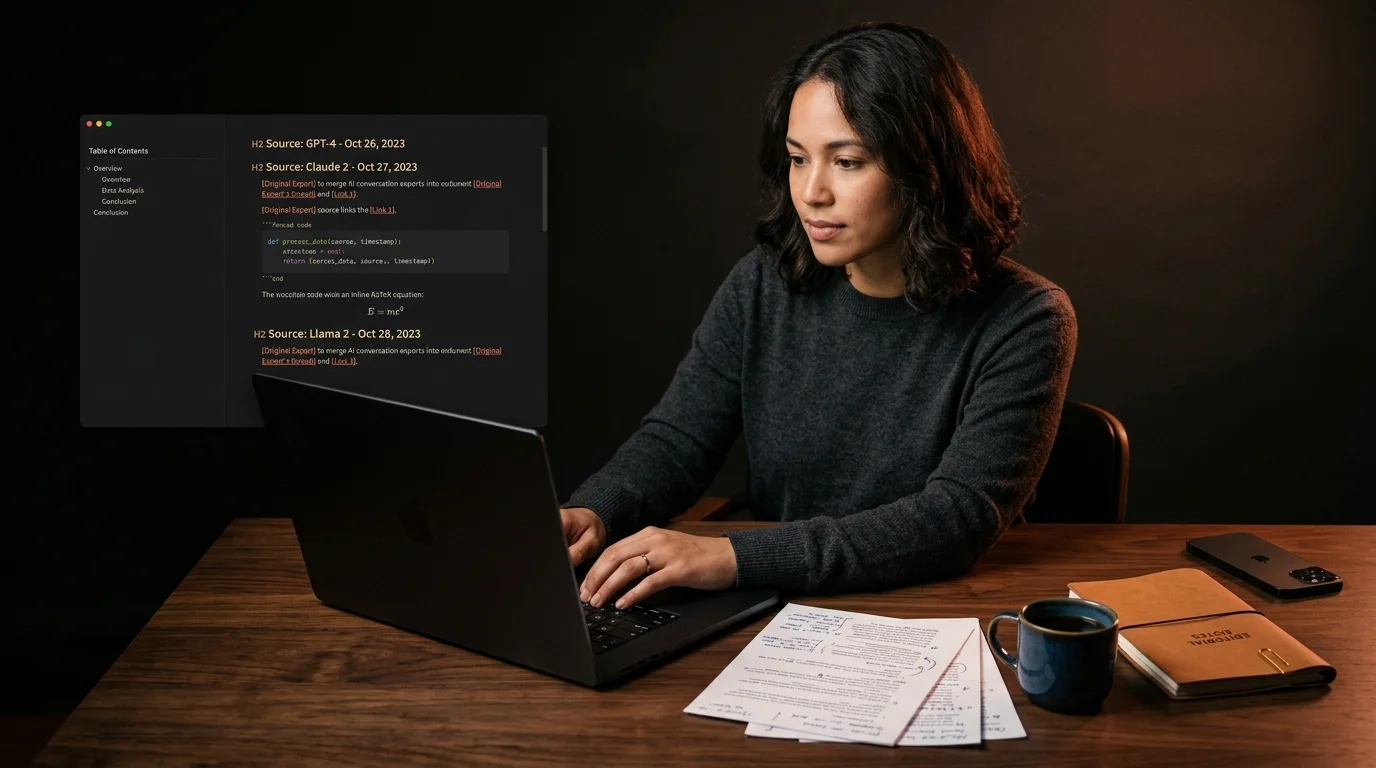
Treat the export, not the chat URL, as the authoritative source. ChatGPT, Claude, and Gemini all have an export route, but they hide it in different places, and the format varies. The workflow for ChatGPT and Claude is covered in our ChatGPT export guide and the long Claude thread guide. Gemini needs the share-link trick laid out in the Gemini export guide. Save the markdown file with a slug that includes the date, the model, and a short prompt summary, like 2026-06-26-gpt5-meta-analysis-prompt.md.
Open the file in a renderer that preserves the math, code, and citations so you can quote from the rendered output, not the raw markdown. Reviewers occasionally ask for a PDF of the source, and a clean reader saves you the print-dialog mess described in the PDF print guide. Store the file in a cloud folder with versioning turned on so the retrieval date in your citation matches a real, dated file. Dropbox, Google Drive, and OneDrive all keep version history for at least 30 days on free plans, and longer on paid ones. That version history is the receipt if anyone questions when you ran the prompt.
Write the citation against the saved file
The retrieval date in your citation should match the modification date of the saved markdown, not the chat URL date. That alignment is what makes the citation reproducible. If a reviewer requests the source, you send the markdown file along with the PDF, both of which are dated. Most journals now accept supplementary materials of this kind, and many require them when AI is cited. The chat URL becomes a pointer, useful but no longer load-bearing.
Keep the prompt verbatim in your notes, including any system context you supplied. A paraphrased prompt is a different prompt, and a different prompt is a different source. The APA guidance is explicit about this: the prompt belongs in the body of the text, not buried in the reference list. The reference list entry handles the model, the version, the date, and the developer. The body of the paper carries the prompt and the quoted output.
Two patterns that work for most writers
For short citations inside a longer paper, the cleanest pattern is to name the model and the date inline, then keep the full reference in the bibliography. For example, "Claude 3.7 (Anthropic, June 26 version, queried 2026-06-26) returned a five-step derivation that..." reads naturally and gives the reader everything they need. The bibliography entry holds the URL of your saved file, not the chat URL. This pattern works across APA, MLA, and Chicago with only small punctuation changes. It also reads cleanly in a printed PDF, which still matters for journal submissions.
For longer reports that lean heavily on a single AI thread, treat the conversation like an interview transcript. Cite it once at the top of the section with a footnote that links to the saved markdown. Then quote freely from the transcript without repeating the citation on every paragraph. This is the same pattern qualitative researchers use for interview data, and it works well for AI threads of more than a few thousand words. The Modern Language Association published their own AI citation rules in 2023 and has updated them twice since, so check the date on whichever style guide you reach for.
FAQ
Does the saved markdown file need to be public? No. The reference entry can point at a private file, with a note that the file is available on request. Most journals accept this for supplementary material, the same way they accept private datasets. The reviewer or editor can ask for the file directly if they want to verify the source.
What if the conversation includes images or generated diagrams? Save the images alongside the markdown file in the same folder, and reference them with relative paths. A renderer that handles Mermaid and inline images keeps the rendered version honest. The math and Mermaid guide covers the rendering side. Treat the images as part of the saved source, not as separate artifacts.
Can I cite a deleted ChatGPT thread? Only if you saved the export before it was deleted. The chat URL is not a stable source, and most reviewers will not accept it as one. Treat the export as the source from day one. The chat panel is for drafting, not for archiving.
Does the citation change when the model is updated? Yes, the version is part of the citation. A response from Claude 3.7 in June is not the same source as a response from Claude 4 in October, even if the prompt is identical. The version string in your citation is what distinguishes them. Write it down at the time of the query, since the chat UI does not always surface it later.
The chat URL is a starting point, and the saved markdown file is the citation. Build the habit of exporting every AI thread you might cite, and the peer review process stops being a scramble for screenshots. The reviewers get a real source, you get a real archive, and the citation holds up under the next round of edits. Once the habit lands, you stop losing weekends to chasing dead links.
Keep every AI source citation-ready from the moment you export
Free to start — no credit card.
Related reading
Ready to read your own AI documents?
Open ChatGPT, Claude, Gemini, or any markdown file in the reader built for the way models write.
- ✓Renders code, math & Mermaid out of the box
- ✓Works offline once you've opened a doc
- ✓Free forever for personal reading